
Blog Post
Best Time to Water Grass in Florida: A Palm Coast Guide

Author: Keith Connolly
September 1, 2026
If you’re standing at the sprinkler timer trying to decide when to run it, set it for the early morning. That’s the best time to water grass in Florida, when the air is cool and the water soaks in instead of burning off. You don’t get to pick the days, though. In Palm Coast and…

If you’re standing at the sprinkler timer trying to decide when to run it, set it for the early morning. That’s the best time to water grass in Florida, when the air is cool and the water soaks in instead of burning off.
You don’t get to pick the days, though. In Palm Coast and Flagler County, the rules say which days you’re allowed to water at all, and which hours. A lot of homeowners are still on the schedule they set back in spring, watering more than the lawn needs, without checking whether those are still their days.
On this page
- What Is the Best Time of Day to Water Grass in Florida?
- What Days and Hours Are You Allowed to Water in Palm Coast?
- How Much Water Does a Florida Lawn Actually Need?
- How Long Should You Run Your Sprinklers?
- How Do You Know When Your Lawn Needs Water?
- Does It Matter What Kind of Grass You Have?
- Does the Watering Schedule Change With the Seasons?
- What Happens If You Water Too Much?
- Does Your Sprinkler System Need a Rain Sensor?
What Is the Best Time of Day to Water Grass in Florida?
Early morning is the best time of day to water grass in Florida, roughly between 4 and 10 a.m. That’s what the grass wants. The best time to water your lawn is one question, though, and the hours you’re allowed to water are another. In Palm Coast, the city doesn’t allow watering between 10 a.m. and 4 p.m., so a morning run has to be done by 10. A shortage order can end the morning earlier, so check your own schedule before you set the timer.
Morning works because the air is cool and the wind is calm, so less water is lost to evaporation, and the blades have all day to dry off.
Midday is the most wasteful, since the heat evaporates a large share of the water before the grass can use it. Watering at night is the hardest on the lawn. Water sits on the blades for hours in the dark, which is exactly what lawn fungus needs to get started, and brown patches often follow. Late afternoon isn’t much better, since there isn’t enough daylight left to dry the grass.
What Days and Hours Are You Allowed to Water in Palm Coast?
Palm Coast gives you two watering days a week when the clocks are ahead, roughly March to November, and one when the clocks are back, November to March. You can’t water between 10 a.m. and 4 p.m. on any day of the year. Both rules come from the city, in Ordinance 2009-15. During a drought, a water shortage order from your water management district replaces those days for as long as it runs.
Your district. Flagler County is in the St. Johns River Water Management District. That matters, because a lot of Florida watering articles quote the Southwest Florida Water Management District, which covers the Tampa area and doesn’t apply here.
Your days. Ordinance 2009-15 sets the days by address, and the schedule switches with the clock change in spring and fall.
| Address | When the clocks are ahead, spring to fall | When the clocks are back, fall to spring |
|---|---|---|
| Odd-numbered, or no number | Wednesday and Saturday | Saturday |
| Even-numbered | Thursday and Sunday | Sunday |
| Businesses and other nonresidential | Tuesday and Friday | Tuesday |
A water shortage order can replace this schedule, so check the district’s watering restrictions page before you set the timer.
Those are the most days you’re allowed, not the days you have to water. A private irrigation well follows the same days and hours as a city meter.
When a shortage order takes over. During a drought, the St. Johns River Water Management District can declare a water shortage order that tightens the watering days and hours. That order replaces the city’s schedule for as long as it runs. When it’s lifted, the seasonal schedule for that time of year takes over again.
The year-round city rules. A few rules hold no matter which schedule is in effect. Under Ordinance 2009-15, the City of Palm Coast doesn’t allow watering between 10 a.m. and 4 p.m. on any day of the year. The rest of your day is open under the city’s rules. The caps hold too: no more than three-quarters of an inch of water per zone, and no more than one hour of run time per zone. The ordinance allows penalties up to $500, and if you want to know how the city handles that, call Palm Coast Customer Service at 386-986-2360.
Reclaimed water. Reclaimed water is highly treated recycled water that the City of Palm Coast supplies for lawn irrigation in some neighborhoods. The ordinance allows reclaimed water anytime. A home with a retail reclaimed meter isn’t held to the watering days or the 10 a.m. to 4 p.m. hours. The city has also said reclaimed customers aren’t held to the restricted schedule during a water shortage, and Palm Coast Customer Service can confirm what applies at your address. If reclaimed water is available at your address, you’re not allowed to also use a private irrigation well. Palm Coast Customer Service, at 386-986-2360, can tell you whether your address is on reclaimed water.
How to check your own address. The St. Johns River Water Management District’s watering restrictions page is where you find out whether a shortage order is in effect and what the watering schedule is right now. Or call the district at 386-329-4500. The City of Palm Coast keeps its own rules on its water conservation page. For questions about city water and reclaimed water, Palm Coast Customer Service is at 386-986-2360. Check before you set the timer, because the schedule a neighbor remembers may not be the one in effect right now.
Whatever schedule applies at your address, the timer has to be reprogrammed to match it, because a sprinkler system runs whatever days were last programmed into it, right through a schedule change. So when the clocks change or a shortage order takes a day away, set the controller to the new schedule, and don’t make up the lost day with a longer run. The amount per zone doesn’t change, a half inch to three-quarters of an inch put down deep, and that’s enough to carry an established lawn.
The rules make one exception that catches people off guard, and it’s for new landscaping. A lawn that was just sodded doesn’t follow the same schedule as the rest of the street, because new grass is allowed more water while it roots in. How much more depends on whether a shortage order is running, the same way the regular schedule does. Our page on sod installation in Palm Coast covers how to water a new lawn and how the rules make room for one.
How Much Water Does a Florida Lawn Actually Need?
An established Florida lawn needs about a half inch to three-quarters of an inch of water at a time. That amount is meant to carry the lawn for the week, not for a single day. On sandy soil that’s about what it takes to wet the ground down a foot. Most Florida lawns need watering about once a week rather than a little every day.
Watering deep and less often beats watering a little every day. A deep soaking pushes the roots down to look for water, and deep roots are what carry a lawn through a dry stretch. Frequent light watering leaves you with shallow roots near the surface where they dry out fast, and the lawn ends up weaker for it.
Rain counts toward the total, so skip the next cycle after a good soaking rain, and a rain gauge is the simplest way to know how much you got.
How Long Should You Run Your Sprinklers?
There’s no single right number of minutes to run your sprinklers, and anyone who gives you one is guessing about your yard. Different sprinkler heads put out water at very different rates, which is why 20 minutes is plenty in one yard and 30 minutes is nowhere near enough in the next.
Find your run time with a few empty cans
One zone at a time. You are aiming for a half inch to three-quarters of an inch of water in the can.
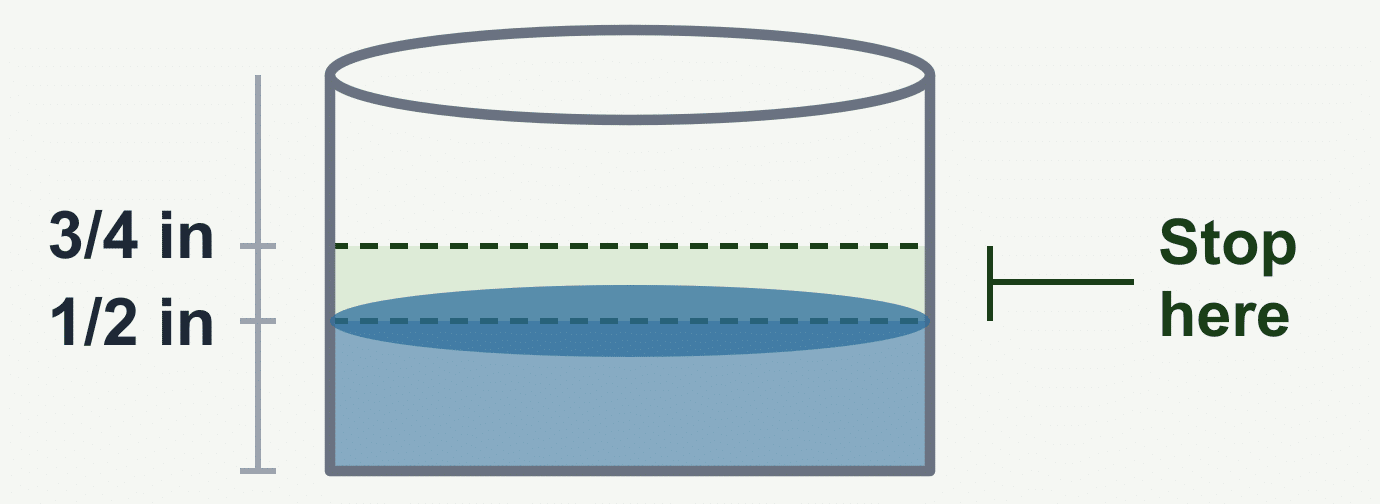
- Set several empty cans around the zone, tuna or cat food size, with straight sides.
- Run that zone and watch the clock.
- Stop when the cans have collected a half inch to three-quarters of an inch, and that’s your run time for that zone.
- Do it again for every zone, since zones almost never match.
Head type explains most of the difference. Spray heads fan out a fixed sheet of water and put it down fast, while rotors turn back and forth and shoot a stream much more slowly. A spray zone may need roughly a quarter of the run time a rotor zone needs.
Watch for runoff while you’re out there. The soil in Flagler County is mostly sand and it drains fast, but it still sheds water when you put it down faster than it soaks in, especially on a slope. Water heading for the street is water the grass never gets. The fix is cycle and soak, which means splitting one long run into two shorter runs with a break in between so the water has time to sink in. A sprinkler head that isn’t set right is one of the things we notice on a yard, and a head throwing water on the driveway is wasting it too.
Once you have a time for each zone, add them up. In Palm Coast, the city caps any one zone at one hour of run time, whatever schedule is in effect. A morning run also has to be done by 10 a.m., and a shortage order can end the morning earlier. Count backward from there to set the start time. If you’re splitting a zone for cycle and soak, the break counts too, so leave room for it.
How Do You Know When Your Lawn Needs Water?
A lawn will tell you when to water, and there are three signs to watch for. The blades fold in half the long way instead of lying flat and open, and the color shifts from green toward a dull blue-gray. Footprints also stay visible after you walk across the yard, instead of the grass springing back up. Any one of those means it’s time to water, and if you’re seeing all three, the grass has needed it for a while.
A lot of homeowners water on every allowed day whether the grass needs it or not. Watering when the grass asks for it is the habit worth building.
Does It Matter What Kind of Grass You Have?
Yes, the type of grass in your yard changes how much water you should be putting down. Three grasses cover most Palm Coast lawns, and the University of Florida has watering guidance for all three: St. Augustine grass, Bahia, and Zoysia.
St. Augustine grass. Most Palm Coast yards are St. Augustine grass, and it’s the most common lawn grass in Florida. Floratam is the cultivar planted most often, and a cultivar is just a specific variety of the same grass. St. Augustine grass is the thirstiest of the three, and it needs regular watering through a dry stretch to hold up. The University of Florida released CitraBlue in 2018, and it handles dry weather better than the older Floratam, Palmetto, and Raleigh. CitraBlue is slower to show drought stress.
Bahia. Of the three, Bahia needs the least water, and it can often get by without extra watering in a way St. Augustine grass can’t. It turns brown in a dry stretch and greens back up when rain returns, so brown Bahia usually isn’t an emergency. If you have Bahia and you’re following advice written for St. Augustine grass, you’re overwatering.
Zoysia. Zoysia handles dry weather well once it’s established, but it still needs regular watering to stay green, the same way St. Augustine grass does. It also fades faster in a dry stretch than St. Augustine grass does.
All three are warm-season grasses, so they grow hard in the heat, slow down when the weather cools, and need much less water in the cool months.
You can tell which one you have while you’re standing in your own yard, and the quickest way to start is to check for Bahia.
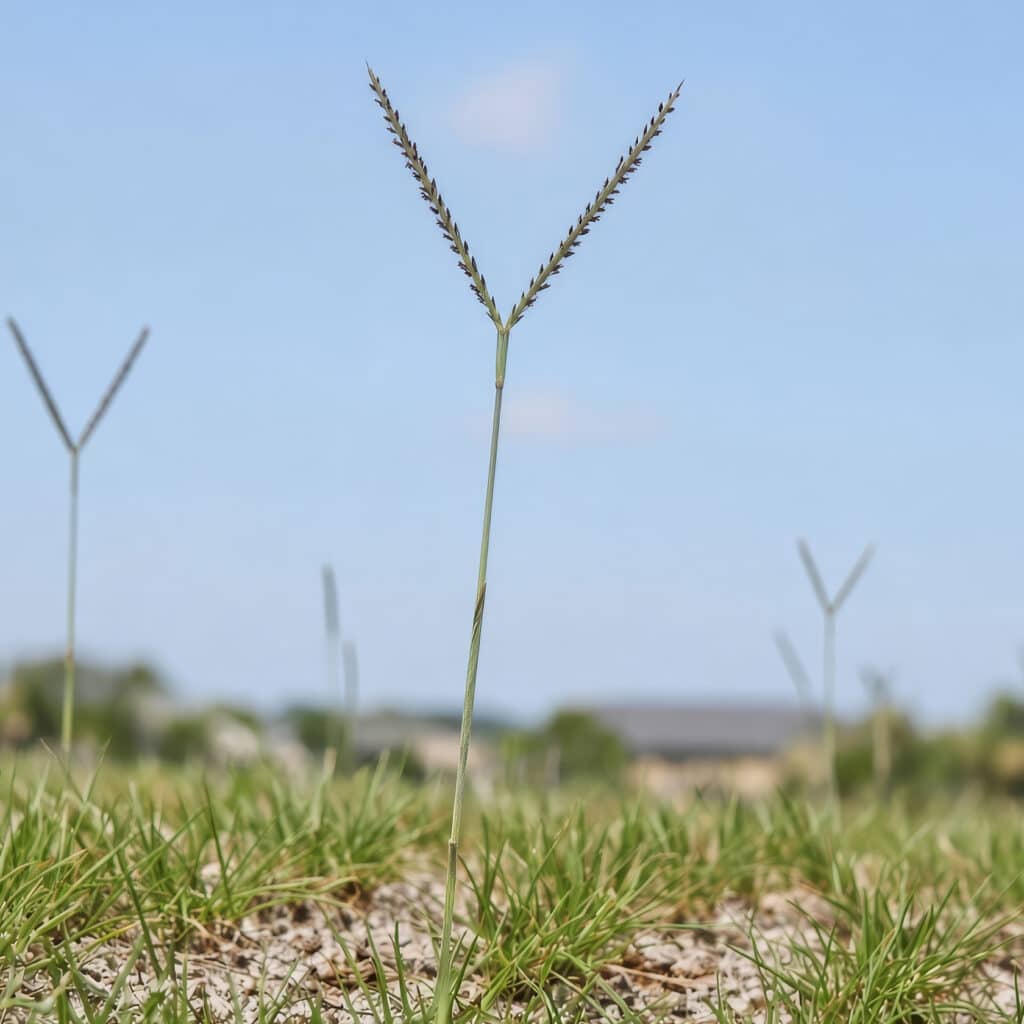
Bahia gives itself away with its seed stalks. A few days after you mow, Bahia sends up tall thin stalks that stand well above the rest of the lawn. Each stalk is topped by two narrow spikes that split apart into a clear V or Y shape. Nothing else in a Florida lawn looks like that, and you can spot it from the driveway without bending down. The University of Florida describes it as a Y-shaped seed head. Two other things line up with it. Bahia grows open and thin instead of filling in like a carpet, so there’s usually some soil showing between the plants, and its leaves and seed stems are tough enough to dull a mower blade.
If you’re not seeing stalks like that after you mow, the answer is in the blades, and it comes down to how wide they are and how they end.
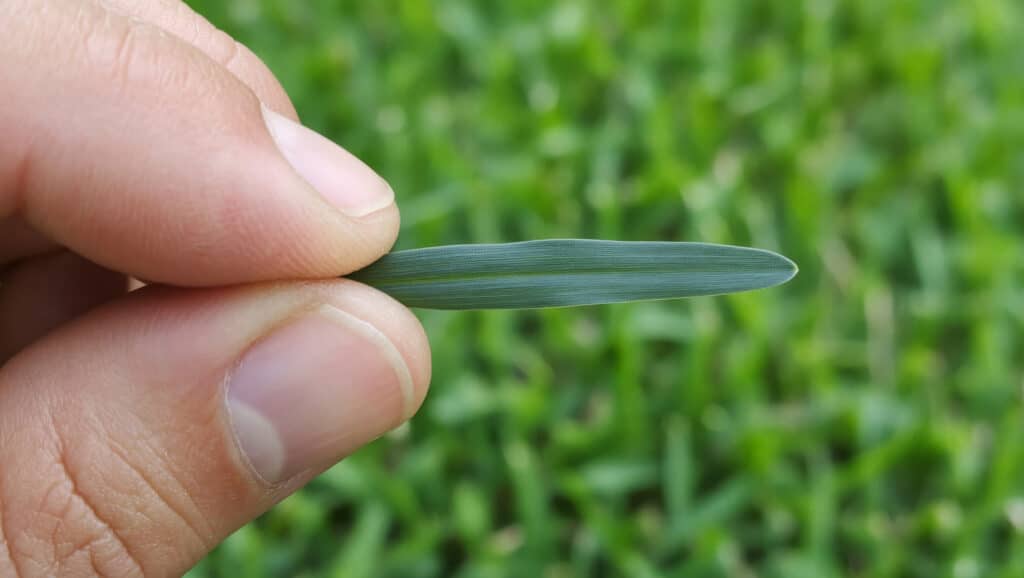
St. Augustine grass has the wide blade. Hold one up and look at the end of it. The blade is broad and flat, and the tip is blunt and rounded rather than pointed, a little like the end of a spoon. The second tell sits down at ground level, because St. Augustine grass spreads by thick runners that creep along on top of the soil, and those runners are easy to see and to lift with your fingers. The place to look is where the lawn meets a flower bed or a driveway, since that’s where the runners run out past the edge.
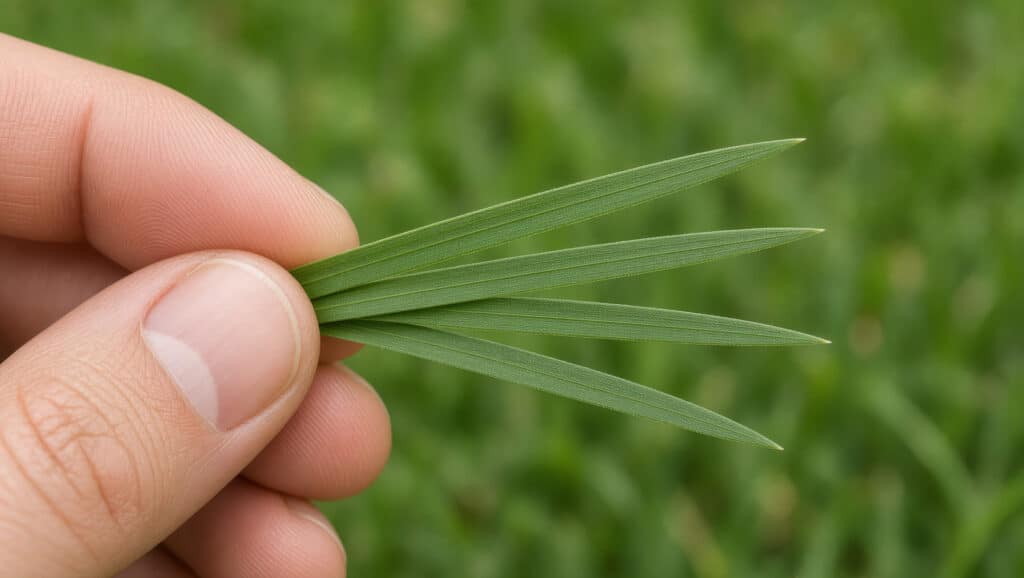
Zoysia is the narrow one, and you can feel it. The blades are thin, they come to a sharp point, and they feel stiff when you run your hand over them. Zoysia also grows into a mat dense enough that weeds have a hard time getting in, so a lawn that feels tight and thick underfoot and has narrow pointed blades is most likely Zoysia.
Knowing which of the three you have is what tells you how much water to put down. Bahia can get by on the least, and St. Augustine grass and Zoysia both need regular watering to stay green.
Does the Watering Schedule Change With the Seasons?
Yes, your watering schedule should change with the time of year, and the biggest change comes in the rainy season. Palm Coast gets roughly 52 inches of rain a year, the wet season runs about July through September, and August is the wettest month at about 6 to 7 inches. In those summer months a good storm often means you can skip the next cycle, and watering the day after a heavy rain is wasted water.
In the cool months the grass slows down and needs far less water. Don’t water more just because it’s technically your watering day, since a watering routine that made sense in June is usually too much for January.
No, 50 degrees is not too cold to water grass in Florida, and a lot of homeowners worry about that one. The part worth planning around is a hard freeze, and it does help to water the soil the morning before. Damp ground takes in more heat during the day and gives it back overnight. Running the sprinklers during the freeze itself doesn’t help a home lawn, and what you get instead is soaked ground, damaged roots, and ice breakage. Water the morning before, then shut the system off before the cold arrives.
What Happens If You Water Too Much?
Too much water causes more lawn problems in Florida than underwatering does, and that surprises a lot of homeowners.
The first problem is disease, because constant moisture is exactly what lawn fungus needs, including brown patch, large patch, and gray leaf spot. The second is a shallow root system, because frequent light watering keeps the roots near the surface where they never have to reach down. That leaves the lawn weaker when dry weather comes. Overwatering also builds thatch, which is the spongy layer of dead material that collects at the base of the grass.
The confusing part is that overwatering and chinch bugs both turn patches of grass brown, and homeowners mix the two up all the time. Chinch bugs are the number one pest for St. Augustine grass in our part of Florida.
The damage looks the same either way, so what separates them is where in the yard it shows up. Chinch bug damage starts in the hottest, driest parts of the yard, usually along driveways, sidewalks, and south-facing edges. Fungus from too much water starts in the damp, shady, low spots that stay wet the longest. Look at where it started before you decide which one you have.
Weeds are a tell of their own, and dollarweed is the one to look for on a lawn that’s getting more water than it needs. The University of Florida says dollarweed is a strong sign of wet ground. It’s easy to pick out, because it grows one round leaf per stalk, and that leaf gets up to about the size of a silver dollar. The whole plant looks like a small lily pad sitting in the grass. Sedges and doveweed like wet ground too.
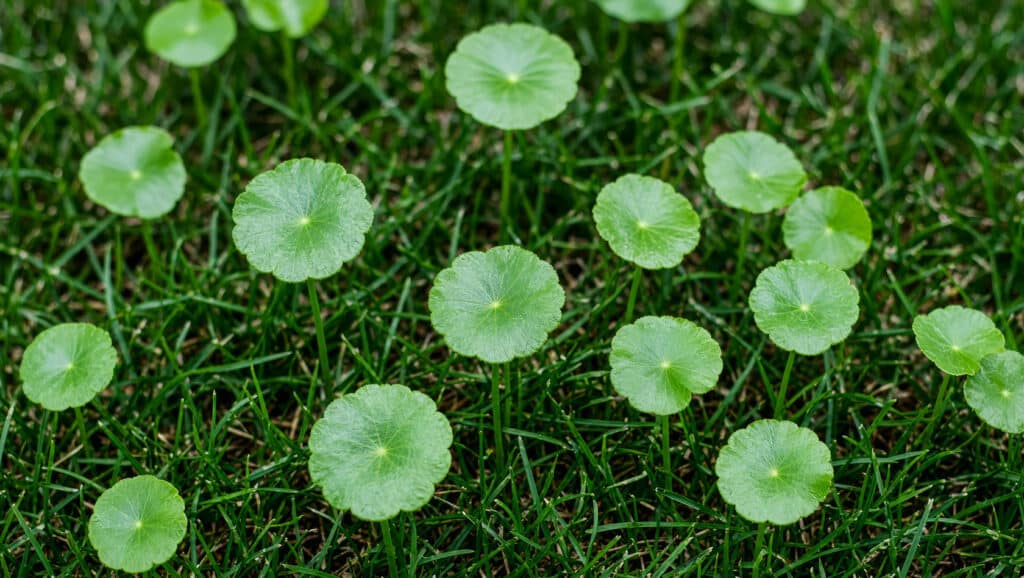
A patch of dollarweed on its own doesn’t prove anything, though, and the University of Florida is clear that one or two kinds of weeds aren’t enough to tell you what’s wrong. A yard full of it, or dollarweed and sedges spreading together, usually points at too much water, unless that part of the yard is naturally wet or sits low to begin with. The fix is watering less often, or putting down less water when you do. Ground that stays spongy underfoot on a day it hasn’t rained, and mushrooms coming up in the grass, point the same direction.
Does Your Sprinkler System Need a Rain Sensor?
Yes, Florida law requires an automatic irrigation system to have a working device that shuts the system off when there’s already been enough rain. Whoever runs the system has to keep it working, not just install it once. The rule is Florida Statute 373.62. In plain words, it’s a small sensor that tells your timer to skip a cycle when the ground is already wet. The law allows a rain sensor or another shutoff device that does the same job, like a soil moisture sensor.
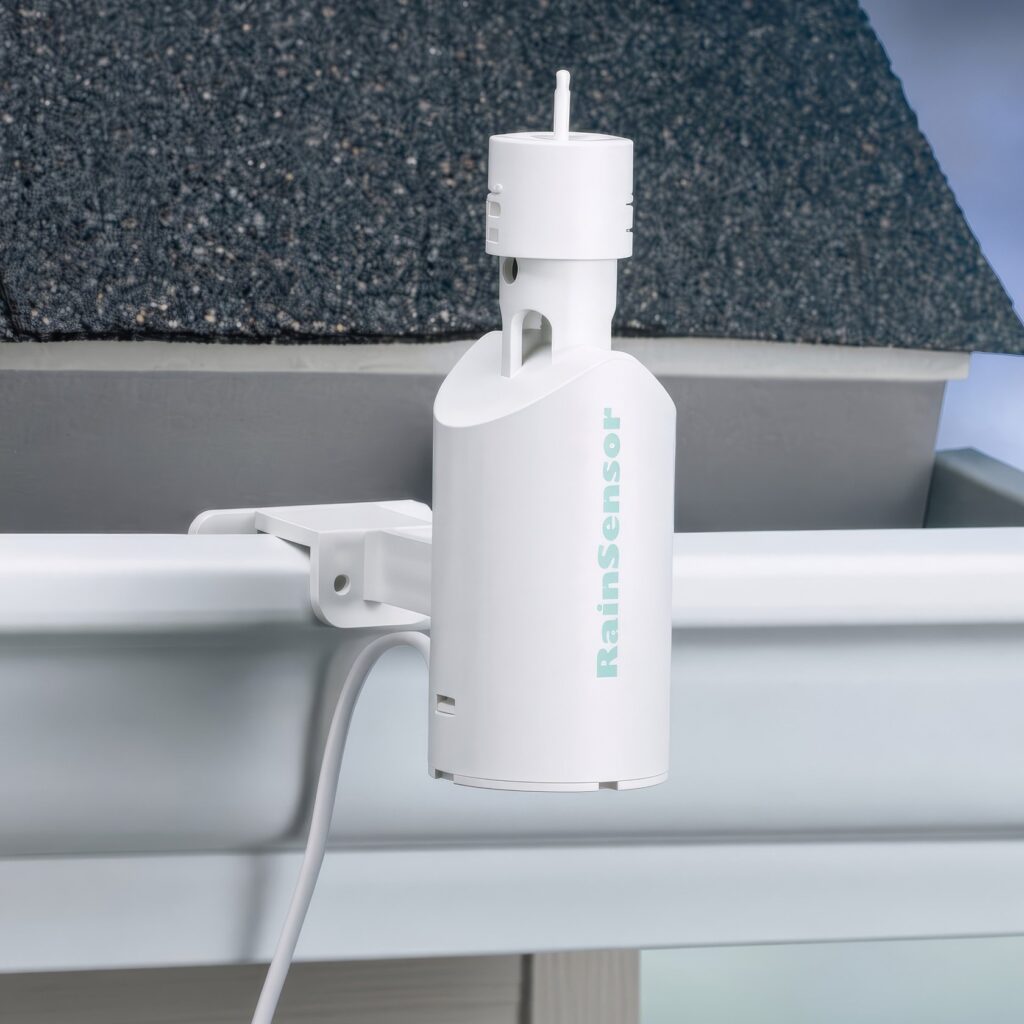
Rain sensors wear out, so one that worked when your sprinkler system went in may not work now. Testing yours takes about two minutes. Start a zone, then wet the sensor or press it in by hand, and the zone should shut off.
If the zone keeps running when you test it, the switch on the controller is the first place to look. Most controllers have a small switch that reads ACTIVE and BYPASS. On BYPASS, the controller ignores the sensor, so the system waters right through a rainy week. That switch gets flipped during a dry stretch, or by whoever worked on the system last, and then it never gets flipped back. Set it back to ACTIVE and run the test again.
Where the sensor sits matters just as much, because rain has to be able to land on it. The University of Florida names the things that keep a sensor from working. It can be under an overhang, hidden down inside a shrub, or under a big tree, and it can also be mounted sideways or clogged with moss, airplants, or spider webs. A wireless sensor also needs a live battery and a signal the controller can pick up, and a wired one needs its wires still attached at the controller.
Watering Questions About Your Own Lawn?
Questions about the watering rules go to the St. Johns River Water Management District and the City of Palm Coast. They set the schedule, and they know when it changes. For questions about your own yard, it’s easier to ask somebody who’s out on Flagler County lawns every week. We’re Connolly Landscaping, a family-run lawn care business in Palm Coast. Call or text Keith at 386-243-5451, or send us a note through our contact page.
Consistent. Reliable. Old School.
Written By: Keith Connolly
Keith Connolly owns and runs Connolly Landscaping in Palm Coast, Florida. He has been working outside on homes since he was twelve, starting with a paper route and a summer job mowing lawns, and he has spent more than thirty years in the outdoor trades since. He runs the company with his two sons, Brandon and Shane, on the same old-school rules: the same crew, the same schedule, and the job gets finished before anyone leaves.
Contact us today
Our team is committed to reliable service, quality workmanship, and making your property stand out. Contact us today for a free estimate, and let’s bring your vision to life.