
Blog Post
How Much Does a Paver Patio Cost in Palm Coast?

Author: Keith Connolly
October 19, 2026
What a paver patio costs in Palm Coast and Flagler County, what changes the price on Florida sand, and how to get a free estimate from Connolly Landscaping.

Our paver patios usually run about $15 to $30 per square foot installed. Every property is different, so treat that as a starting point, not a quote.
The biggest thing that moves your paver patio cost is size. Here’s that range worked out for four common patio sizes:
- A 12×12 patio (144 square feet): about $2,200 to $4,300
- A 200 square foot patio: about $3,000 to $6,000
- A 300 square foot patio: about $4,500 to $9,000
- A 20×20 patio (400 square feet): about $6,000 to $12,000
The cost per square foot is usually higher on a small patio than a large one, because some costs don’t shrink with the patio. A small job still needs the same equipment, the same delivery minimums on rock and sand, and the same time to set up the site. On a small patio, those fixed costs are spread over less square footage.
Walkways and driveway widening are priced the same way, by the square foot, and we do both.
The exact number for your yard comes from a free estimate. Connolly Landscaping installs paver patios, pool decks, and walkways in Palm Coast and across Flagler County. At the estimate visit, we look at your access and whatever is already sitting where the patio will go.
If you’re pricing a patio for yourself or for a parent, the rest of the number comes down to your yard, your ground, and what you add.
On this page
- What Changes the Price of a Paver Patio?
- Concrete Pavers or Travertine: What Does Each Cost?
- Are Pavers Cheaper Than Poured Concrete?
- Why Does a Patio on Palm Coast Sand Cost More to Build Right?
- Do You Need a Permit for a Paver Patio in Palm Coast or Flagler County?
- What Does a Paver Pool Deck Cost?
- Is a Paver Patio Worth the Money?
- How Do You Pick a Paver Installer, and What Should the Quote Include?
What Changes the Price of a Paver Patio?
The pavers themselves are usually less than half the bill. The rest of the installation cost is labor, site preparation, and the details of your yard. That’s why two quotes for the same patio can be thousands of dollars apart.
Material cost is easy to compare from one quote to the next. Labor costs and site conditions aren’t. They come down to the four questions below.
Can the Crew Get Equipment Into Your Yard?
When a machine can reach the patio spot, the work goes faster and costs less. That machine is usually a skid steer, a compact loader that carries rock and sand. When it can’t get in, our crew moves the rock and sand by wheelbarrow, and the labor cost goes up.
The usual Palm Coast obstacles are a narrow side yard, an air conditioner pad in the path, and a fence with a gate too narrow for a machine. We check access during the estimate visit, so it’s in the price from the start.
Is There an Old Concrete Patio to Remove First?
If there is, taking it out adds to the cost. The slab usually has to be broken up and hauled off before a proper base can go in. We handle the removal as part of the job.
Taking the old slab out matters because a cracked or sinking slab passes its problems to anything laid on top of it. So we look at the old slab during the estimate and tell you what it needs, instead of promising that pavers can go over it.
What Shape, Pattern, and Size Do You Want?
A square or rectangle laid in a simple pattern is the least expensive patio to build. Curves, borders, and detailed patterns like herringbone cost more, because every cut takes time and wastes pavers. We’ll price whatever shape you want.
The pattern also changes how many pavers get ordered. In a herringbone pattern, the pavers sit at angles to each other, so many get cut along the edges. A running bond sets them in staggered rows, like bricks in a wall, with fewer cuts. So a herringbone patio needs more pavers ordered than a running bond the same size.
Size works the other way. The bigger the patio, the less each square foot costs, because the setup costs are spread over more ground.
Do You Want a Fire Pit, Seat Wall, or Outdoor Kitchen?
Extras are priced as separate items on top of the patio. The usual ones are a fire pit, seat walls, steps, an outdoor kitchen, landscape lighting, and footings for a pergola.
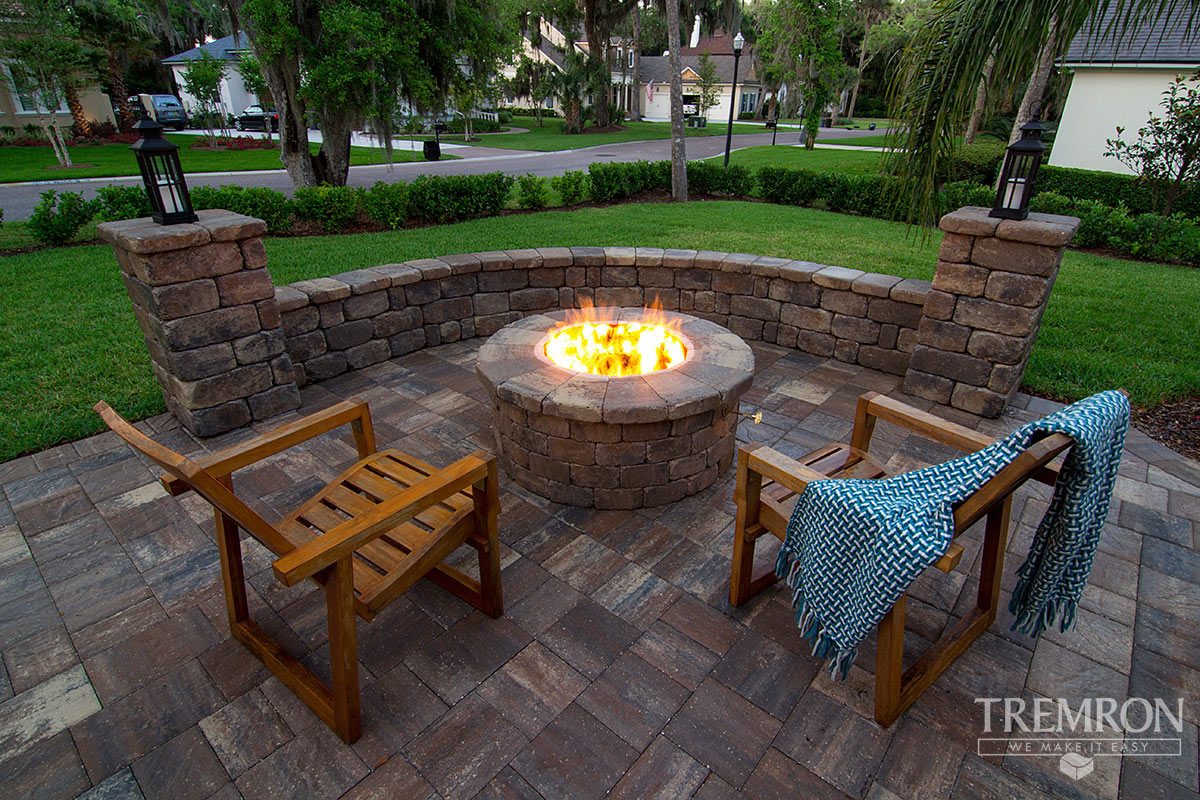
Tell us what you want before the estimate. A fire pit or lighting changes how we build the base, and adding it later costs more than planning it now.
Concrete Pavers or Travertine: What Does Each Cost?
Standard concrete pavers cost the least. Textured and large-format concrete pavers cost more, and travertine usually costs more than standard concrete. Here’s roughly what each runs when we install it:
- Standard concrete pavers (uniform shapes in a range of colors): the low end of our range, up to about $18 per square foot
- Premium concrete pavers (textured finishes, planks, and large slabs that read closer to cut stone): toward the top of the concrete range and above
- Travertine (a soft, tumbled surface in a light, warm color): about $18 to $28 per square foot
Other natural stone pavers, such as flagstone, usually run toward the top of the travertine range and above.
The prices in that list are our usual starting points. Your pattern and your yard move the number from there.
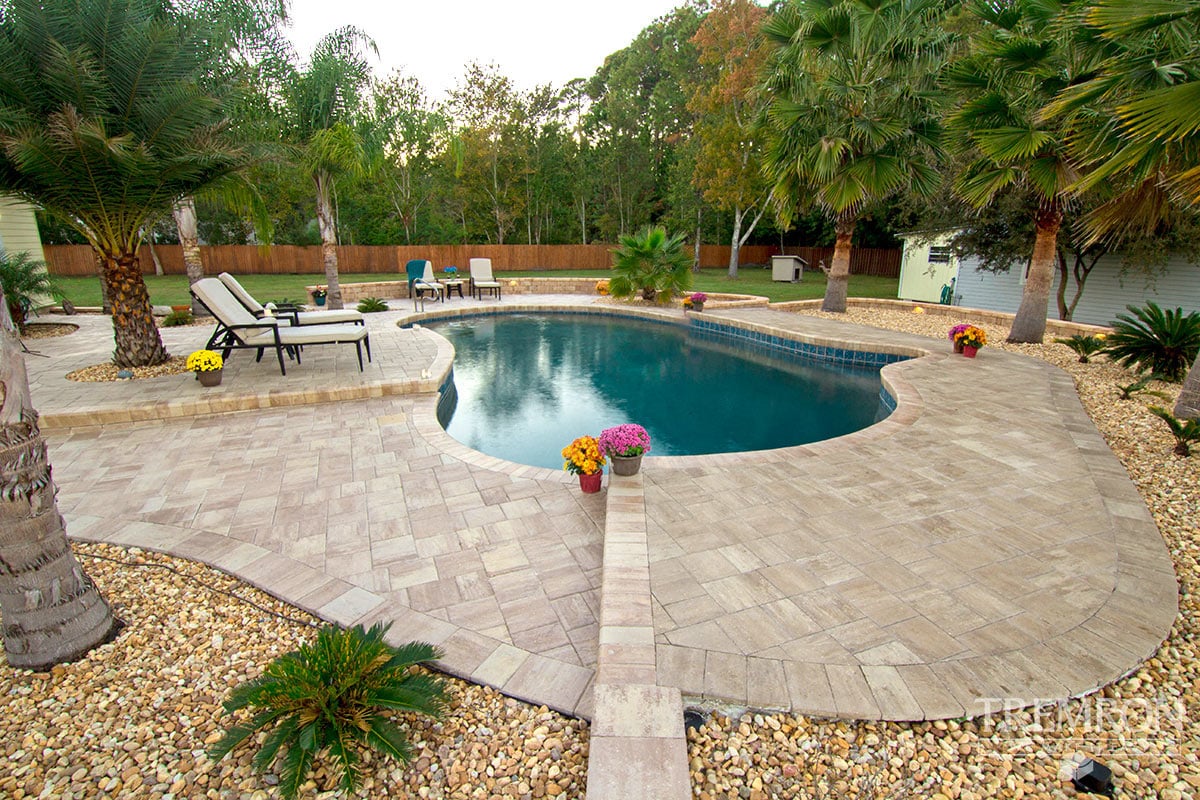
We install Tremron concrete pavers, made in Florida, and Keystone Tile travertine. You see the options and choose at the estimate visit.
Are Pavers Cheaper Than Poured Concrete?
No. A poured concrete patio usually costs less up front than pavers. The case for pavers is what happens after the first few years.
Concrete cracks, and a patched crack always shows. On a paver patio, a worn or sunken spot can be fixed a few pavers at a time, with no patch showing. A cracked slab often ends up torn out and replaced with pavers anyway, which means paying for the patio twice.
Stamped concrete closes some of the price gap and looks closer to pavers. But it’s still one slab, and it cracks the same way.
If you only want the lowest number for a plain slab, poured concrete wins. If you want a patio that lasts and can be repaired in pieces, pavers are worth the extra cost.
Why Does a Patio on Palm Coast Sand Cost More to Build Right?
Much of Palm Coast sits on loose, fine sand that can stay wet through the rainy season, so a patio here needs a compacted rock base before a single paver goes down. On that ground, most of the cost is under the pavers. A patio with a thin base can sag, rut, and wash out in the summer rains.
Much of the labor goes into base preparation, because loose sand shifts under weight. Here’s how a patio is built right on this ground:
- Excavate the footprint. Dig out the whole patio area, deep enough for every layer below.
- Compact the soil. Wet the sand underneath and run a plate compactor over it. A plate compactor is a heavy machine with a flat steel plate that vibrates and packs loose ground solid.
- Build the base. Bring in the base material, such as limerock or crushed concrete, and compact it in layers until it’s 4 to 6 inches deep, the common depth for a patio.
- Screed the bedding sand. Spread a thin, even layer of coarse bedding sand, about 1 inch, and level it with a straight board. Sand that’s too thick or too fine lets the pavers shift and go wavy.
- Lay the pavers and lock the edges. Set the pavers, then fasten edge restraints (rigid strips spiked into the base along the perimeter) so nothing spreads.
- Sand the joints. Sweep in polymeric sand and compact again. Polymeric sand hardens when it gets wet, locks the pavers together, and helps keep out weeds, ants, and rain washout.
The local yardstick is the City of Palm Coast’s own standard for paver driveways where they cross the right of way (the strip of public land between your property line and the road). It calls for compacted soil and a base packed to 98 percent of the maximum density a lab test says that material can reach. The pavers sit on 1 to 1.5 inches of screened concrete sand, and mason sand and stone dust aren’t accepted. The standard also requires edge restraints on every paver installation.
That standard is built for driveways that carry cars, so it asks for more than a patio needs. But its sand and edge restraint rules are the ones a patio should follow too.
We grade the patio with a gentle slope away from the house, so rain runs off instead of pooling. We also make sure the surface is even along that slope before a paver goes down.
A low quote usually means a thin base, and that’s where the money goes wrong.
Do You Need a Permit for a Paver Patio in Palm Coast or Flagler County?
The City of Palm Coast has separate permit categories for paver installation and for patio work. The building department for your address makes the call. Inside Palm Coast, that’s the City of Palm Coast Building Division. Bunnell, Flagler Beach, and the rest of the county have their own offices.
Some parts of a project come with extra requirements:
- Pavers that reach the street, the sidewalk, or the right of way (the strip of public land between your property line and the road)
- A pool deck or pavers around a pool
- A plan to add a screen enclosure over the patio later, because Palm Coast requires a permit and engineered drawings for a screen enclosure
- New electrical or plumbing for lights or an outdoor kitchen, which needs its own permit
HOAs are a separate check. Many Palm Coast neighborhoods have no HOA. Gated and deed-restricted communities usually require an architectural review before any patio or walkway work. Check your HOA documents before you start.
We pull the permit when your project needs one. It’s part of the job.
What Does a Paver Pool Deck Cost?
A paver pool deck often costs more per square foot than a patio the same size. Three things add to it: the coping (the finished edge that caps the rim of the pool), the cuts needed to fit pavers around a curved pool, and the permit work that often comes with a pool deck.
Travertine is a common choice around pools here. Light-colored tumbled travertine stays cooler under bare feet than darker concrete in the Florida sun. Its textured surface also grips better when it’s wet than a smooth or polished finish does. We install Keystone Tile travertine and coping to match.
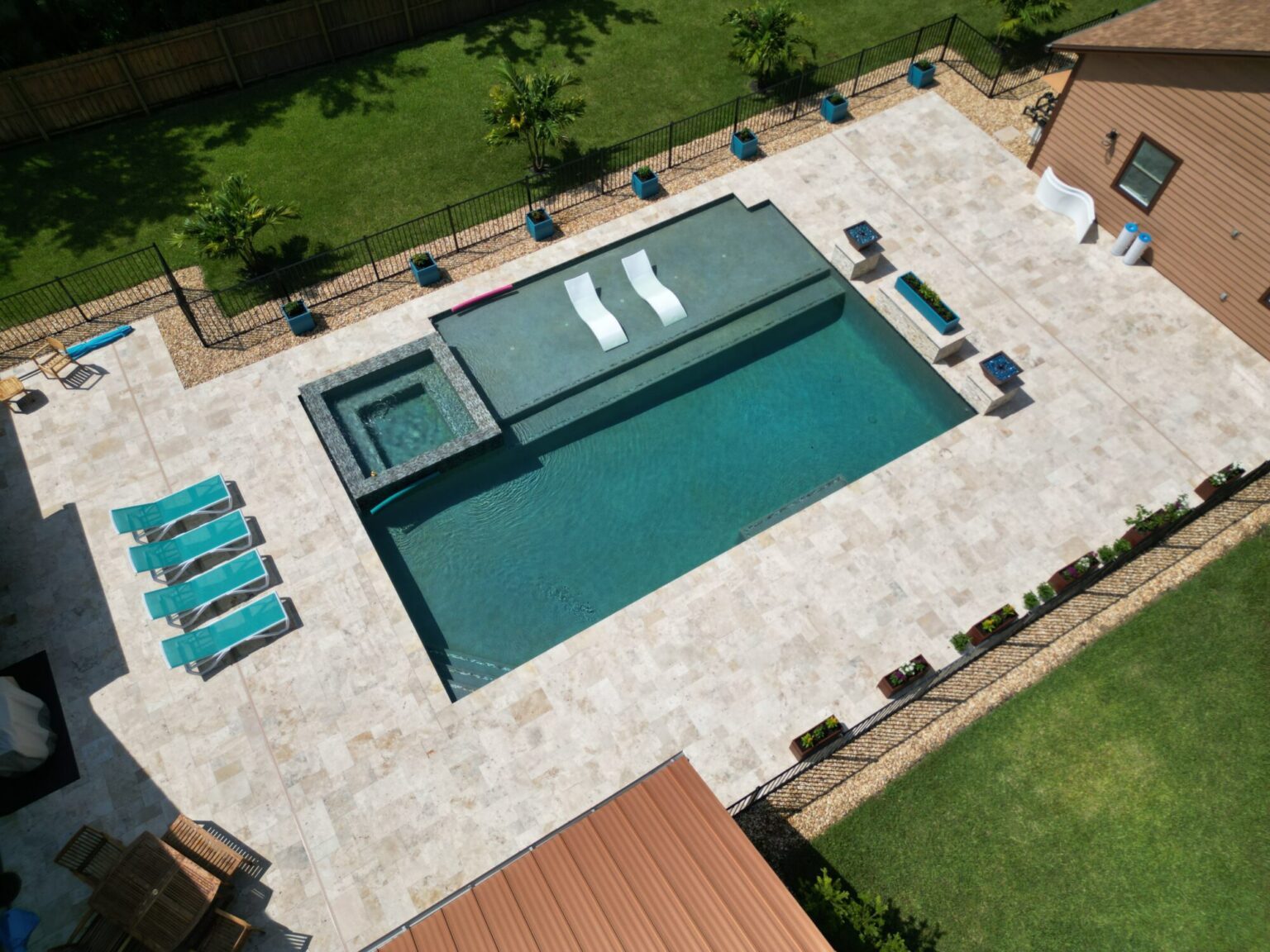
If you have an old concrete or coated pool deck, it often comes out first, and we cover that in the quote. You get your number at the estimate visit.
Is a Paver Patio Worth the Money?
For most homeowners, yes. A paver patio built on a proper base lasts for decades and costs little to keep up. Pavers commonly last 25 to 50 years, and that durability is what you’re paying for.
Upkeep is plain: rinse it off, top up the joint sand every few years, and seal it if you want the color to hold and stains to wipe up. Sealing is optional.
If a spot ever sinks, the fix is to lift those pavers, repair the base underneath, and reset them, with no patch showing.
A good patio adds outdoor living space you’ll use every week, and it’s a feature buyers look at when you sell.
How Do You Pick a Paver Installer, and What Should the Quote Include?
Pick the installer who shows you the base, not just the pavers, and whose quote spells out what goes under the patio. A real quote lists:
- How deep they excavate
- The base material and how many inches of it
- The bedding sand (screened concrete sand, not mason sand or stone dust)
- The type of edge restraint
- Polymeric or plain joint sand
- The exact paver line and thickness
- Removal and haul-away of anything old
- Permits
- Cleanup
When two quotes are far apart, the low one is usually missing lines from that list.
We listen to what you want before we price anything. We build the base right, because it’s the part you’ll never see. We stand behind our work.
A typical paver patio takes about 2 to 5 days on site. From first conversation to finished patio, it’s usually 3 to 5 weeks, counting design, permits, and material delivery. Every job is different, so yours may run shorter or longer.
Get a Free Estimate for Your Patio
Book a free estimate visit, and we’ll give you the exact number for your yard. Connolly Landscaping serves Palm Coast and all of Flagler County.
Written By: Keith Connolly
Keith Connolly owns and runs Connolly Landscaping in Palm Coast, Florida. He has been working outside on homes since he was twelve, starting with a paper route and a summer job mowing lawns, and he has spent more than thirty years in the outdoor trades since. He runs the company with his two sons, Brandon and Shane, on the same old-school rules: the same crew, the same schedule, and the job gets finished before anyone leaves.
Contact us today
Our team is committed to reliable service, quality workmanship, and making your property stand out. Contact us today for a free estimate, and let’s bring your vision to life.